The Highland County Press: Proposed Highland Solar expansion reviewed at county commission meeting
Article link: Proposed Highland Solar expansion reviewed at county commission meeting
November 15, 2025
By Caitlin Forsha, The Highland County Press
Highland County commissioners Brad Roades, Terry Britton and David Daniels were updated on plans to expand an existing solar project, with additional acreage for a larger solar development as well as a new battery storage facility, during commissioners’ Wednesday, Nov. 12 meeting.
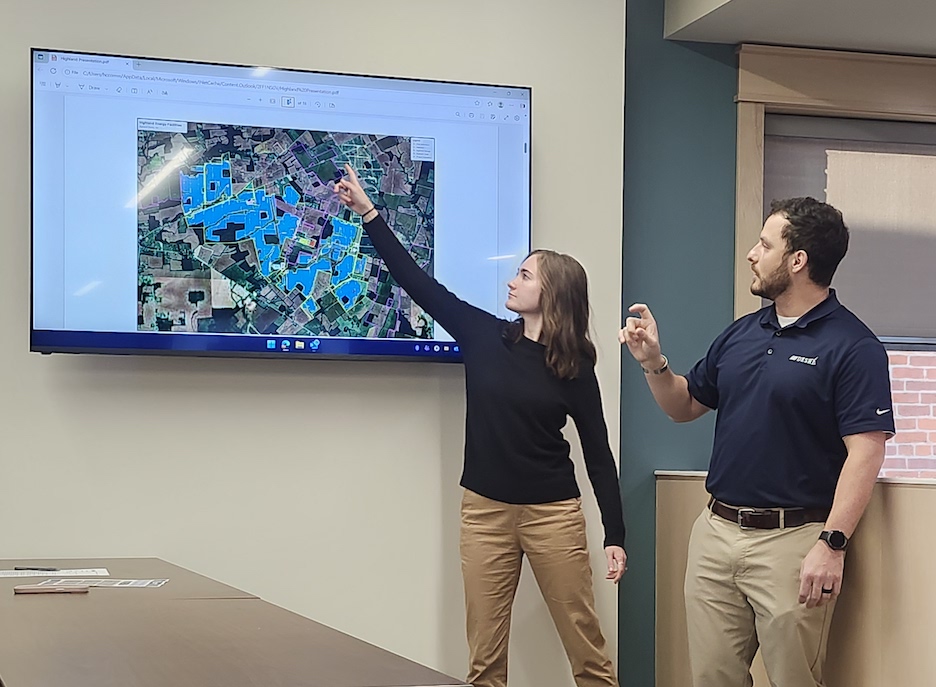
Joel Puritz and Maria Smith-Lopez of DESRI (DE Shaw Renewable Investments) presented a slideshow with information regarding next steps for the Highland Solar I.
As previously reported, the 300 MW Highland Solar project, located in Clay and Whiteoak townships, began commercial operation on Oct. 24, 2024. In March 2025, representatives of DESRI (the project owner/operators) met with commissioners, where Jared Wren of Hecate (the original project developers) said that plans were underway for an additional 230-megawatt project, Nuthatch Solar. Wren said the project is already “qualified” under Senate Bill 52 and would be a “final phase” of their New Market/Highland Solar development.
(Note: In September, commissioners heard a proposal for a 200-megawatt battery storage facility in New Market Township. The proposal discussed Wednesday is a separate and unrelated project.)
According to Puritz, DESRI is “in the very early stages of development” for both proposals. For the state application and approval process through the Ohio Power Siting Board, Puritz and Smith-Lopez said the battery storage facility would be added as an amendment to the current Highland Solar I project, while the new solar development, Nuthatch Solar, would be a separate and new application. With that timing in mind, Puritz said they are “about 18 months to two years out from starting construction on either of these facilities,” assuming they are approved.
For the energy storage facility, Puritz said it is response to increased demand in the region, as well as addressing factors such as power quality and resiliency as well as “shifting energy to when it is needed, not just when it is produced.
“Batteries are a generation-agnostic technology,” Puritz said. “They can be attached to solar. They can be attached to wind projects. They can be attached to natural gas. Any technology that produces energy and may have some sort of need to store it, similar to how a water tower stores water for when we need it, batteries provide unique technological capability to do that exact same function.”
According to the information presented by Puritz, the lithium iron phosphate battery energy storage system, or BESS, is targeted to being construction “no later than the third quarter of 2027,” with commercial operations set to begin approximately a year later. It will be a 300-megawatt, or 1200-megawatt-hour, facility and will be in a construction area of 30 acres among the 55-acre existing site.
“The existing solar facility is about 300 megawatts,” Puritz said. “We are taking this battery and sizing it one to one, so we’re adding a 300 megawatt facility. The battery will be designed to discharge that power for four hours at a time. It is designed around peak energy demand in the afternoon, that four-hour period that grid planners across this state and every other state in the country constantly worry about.
“This is an upgrade to the existing solar facility. The battery will be attaching to all of the same infrastructure that is already built for the solar project.”
Puritz continued that they plan to use some of the land that was purchased and permitted, but not used, for the current Highland Solar project. They are in the “process of amending” their existing application with the OPSB following discussions with county, townships and law enforcement/emergency personnel.
“We are near the intersections of Gath Road and Gregory Road, about 15 miles due southwest of where we’re standing today,” Puritz said. “The logistics of this is we build an access road from Gath Road heading east into the project.
“This entire footprint that I am showing here [during his slideshow] to the east is give or take about 30 acres of temporarily disturbed land. As built, the project will take up about 15 acres in total.”
According to Puritz, their plans also “incorporate … room within our build footprint on day one for additional batteries to be added,” possibly in “three- to five-year increments,” without further expanding the acreage of the project. Once approved by the state, the project construction is expected to take six months to a year, he said, meaning the project may be operational by “the summer of 2028.”
Puritz said that they have already had some discussions “with local fire departments in the area to explain the technology, to explain best practices and to introduce the project as a whole” and that “emergency response plans” will be a part of the entire process.
Following the presentation, Roades asked if the “battery storage facility you’re putting in is going to be charged off of your solar panels.”
“It will actually be charged directly from the grid,” Puritz said. “The solar facility can indirectly charge it. It sends power to the grid, and the grid operator can choose to revert it back to the facility if they choose, but the interface is directly with the transmission system.
“Any battery storage facility nearby, or anything drawing power from the grid that’s close, will draw power from those panels, so this battery storage facility benefits from that proximity and location most directly because it’s right there.”
Smith-Lopez then discussed Nuthatch Solar, which she said would “add another 230 megawatts” to the Highland Solar project.
“This project is not quite as far along as the Highland Storage project, so we have a little bit less firm dates on exactly when we anticipate doing everything, but we are targeting a roughly similar start of operation date in late 2028,” she said. “We will be connecting to the same infrastructure that Highland I and Highland Storage will be interconnecting into. There will just be a small expansion required of the electrical infrastructure on Gath Road, but otherwise it will the exact same location.”
Unlike the battery storage facility within the existing project, Smith-Lopez said Nuthatch Solar will require “about 2,000 additional acres” adjacent to Highland Solar I. She said they are in the process of acquiring some of that land, while some of it “has been under contract since before even Highland I was operating” and was not yet used.
“We have roughly, I would say, two-thirds of our targeted land under option right now or under negotiation with intent to sign in the near future, so we’re still rounding out our exact footprint,” Smith-Lopez said, in response to a question from Daniels.
As discussed in March, the new project “will not be subject to some of the new local authority that Senate Bill 52 has granted projects,” but it will comply with the newly enacted setback requirements, Smith-Lopez said. Once the application is submitted, the Nuthatch Solar project will be subject to the same public comment period and other phases as similar local solar projects.
“This timeline is subject to change, but we are targeting having our certificate approval by before the end of next year, hoping to have it the end of the summer, which means we need to get the application in sometime early next year,” she said. “We’re excited to maximize our use of this infrastructure that we built so we can provide more energy without adding additional cost to the project.”
As the DESRI representatives brought a handout highlighting the PILOT (Payment in Lieu of Taxes) revenues being generated by Highland Solar I, Daniels asked if, and how, the county would benefit financially from the two new projects. Puritz said the BESS would be part of the existing solar project and would not impact the current PILOT, but they are still working with the Ohio Department of Development to determine “the exact dollar amounts or level of participation” the BESS can have.
Daniels also asked about the decommissioning process for the battery storage facility.
“The batteries degrade over time,” Puritz said. “They don’t degrade to the point to where they’re not useful anymore. Your phone battery will probably last, more or less, indefinitely, probably longer than you would even use it. It just won’t last as long as it initially did.
“We add more facilities. Everything that we install stays in place throughout the project life, and then we just add more on after the fact.”
However, once batteries do reach “end of life,” Puritz said there is a “regulatory process” that they follow to safely dispose of the batteries.
Highland County Sheriff Randy Sanders asked if another battery storage facility will eventually be added to the Nuthatch Solar project once it is operational. Smith-Lopez said that “there’s nothing official, but we are preparing to progress toward that point as well” in the future.
For more from Wednesday’s meeting, see the story at: https://highlandcountypress.com/commissioners-proclaim-hunger-and-homel….